

- The recent sunscreen scandals in Australia and South Korea have consumers wondering if they can trust their UV protection.
- Korean sunscreens often use newer UV filters that feel lighter, thinner, and leave no white cast, which is why so many of us love them.
- Korea regulates sunscreen as a functional cosmetic, and the US regulates it as an over-the-counter drug.
-
Some K-beauty brands are reformulating their sunscreens to comply with FDA regulations; others are simply removing SPF, UV, and PA from their labels.
Sunscreen has made a lot of headlines this year. Recalls in Australia, a testing dispute in Korea, and K-beauty bottles that look different in the US than they do in Seoul. My clients keep asking me if their favorite skincare products still include SPF protection, and if they can trust sun-filtering technology.
My answer is yes, when you know what to look for. I've been an esthetician for 26 years, and Korean sunscreens are still my preferred UV protection. Here's how to read the label, why the rules differ in the States, and how to shop with confidence.
DECODING THE RECENT FACE AND BODY SUNSCREEN FAILURES
Skincare brands source their sun-filtering base formula from the same regional manufacturers. They trust their manufacturer to deliver UV protection as promised. If a single product is found to deliver less sun protection than advertised, it often impacts several brands at once. That's exactly what happened in Australia.
Australian consumer group CHOICE tested 20 sunscreens labeled SPF 50 or 50+, and 16 fell short. One tested at SPF 4. Australia's regulator recalled or paused sales of products that shared the same base formula. Similar failures have occurred in Korea, the US, and the UK. Please don't let this scare you away from sunscreen. Let it make you a smarter shopper.
WHY I LOVE KOREAN UV PROTECTION AS A MASTER ESTHETICIAN?
In the US, most sunscreens have one job: blocking UV rays. Korean skincare brands treat sunscreen as a high-performing skincare step, not just a UV layer. In addition to sun protection, you'll often find Peptides, Niacinamide, Hyaluronic Acid, and Botanicals like Centella. These formulations nourish, heal, and hydrate your skin, while protecting it from UV rays. Some products are so advanced, they double as your daily moisturizer. This philosophy is known as the skinification of sunscreen.

Korean skin scientists also utilize a wider range of UV filters. These are the protective ingredients that absorb or reflect the sun's rays. Filters like Tinosorb and Uvinul A Plus are a big reason Korean formulas feel silky and weightless. These filters aren’t all approved by the FDA, which is why you’ll notice that the SPF, UV, and PA ratings are no longer printed on some of the products that I sell. The formulations haven’t changed. Removing the sun protection is how many K-beauty brands remain compliant with sunscreen regulations in the US.
WHY DO SOME KOREAN SUNSCREEN LABELS LOOK DIFFERENT IN THE US?
In Korea, sunscreen is classified as a functional cosmetic. Before a brand can print an SPF or PA rating, the product must pass testing and be approved by Korea's Ministry of Food and Drug Safety.
In the US, sunscreen is classified as an over-the-counter drug. The FDA decides which filters a product can use if it wants SPF on the label. Many filters used in Korea aren't on that list. So, when a Korean brand sells in the US, it usually does one of two things:
-
Formulate a US-only version with FDA-approved filters and a Drug Facts panel on the back. As a result, the weight and texture may feel slightly different.
- Sell without SPF labeling, as a moisturizer, primer, or barrier cream. This is the route many of the Korean brands I sell are taking, which is why you’ll notice that the label looks different.
THE FDA APPROVED A NEW UV FILTER
There's good news, too. In June 2026, the FDA approved bemotrizinol, better known as Tinosorb S. Korean and European brands have used this active ingredient as sun protection for years. New US products will take time to reach shelves, but it's a real step toward giving you the same sunscreens the rest of the world enjoys.
HOW TO READ A KOREAN SUNSCREEN LABEL?
My rule on the treatment bar: UVB burns, UVA ages. You want protection from both, and from blue light!
-
SPF (Sun Protection Factor) measures protection from UVB rays, the ones that burn. SPF 15 blocks about 93% of UVB rays, and SPF 50 blocks about 98%. No sunscreen blocks 100%.
-
Broad-Spectrum is the US term for protection from both UVA and UVB rays. Sunscreen is increasingly broad-spectrum, while UV makeup typically contains SPF, but read the label.
- PA (Protection Grade of UVA) measures protection from UVA rays, the ones behind wrinkles, sagging, and dark spots. PA+++ offers high UVA protection.

WHAT ABOUT FILTERING BLUE LIGHT?
Mineral sunscreens formulated with Iron Oxide, Zinc Oxide, or Titanium Dioxide absorb, block, or scatter the blue light of digital screens and fluorescent lighting. Skincare products with Vitamin C, Vitamin E, and Niacinamide help heal free-radical damage from blue light.
HOW IS SPF TESTED AND RATED IN SKINCARE?
Most of us have never considered how SPF is tested or rated. A lab applies sunscreen to real people and exposes the skin to controlled UV light on a small, localized area. Scientists use advanced technology to measure how long skin takes to redden with and without sunscreen.
HOW TO SHOP AND WEAR SUNSCREEN WITH CONFIDENCE
-
Purchase from trusted sellers: Skip bargain marketplace listings. Counterfeits are common, and heat and age break down UV filters. Buy directly from the brand or from verified resellers such as myself.
-
Read the label and ask your esthetician: Continue to look for SPF, broad-spectrum, and PA ratings. When purchasing from an international brand, ask your esthetician if the product contains sun filters that aren’t approved by the FDA. If you’re unsure if a product provides adequate protection, join my Beauty Club and ask me!
-
Apply generously: Apply at least a quarter teaspoon to your face alone, and more on your neck and chest. Apply at least 1 full ounce to the rest of your body.
-
Reapply at least every 4 hours: Reapply every 4 hours indoors, every 2 hours outdoors, and directly after swimming or sweating. BB creams and serums are the easiest to reapply over makeup.
- Apply year-round: Apply SPF protection every day, every day, every day! UVA passes through clouds and windows, and we’re in front of the blue lights of screens all day long.
MY ESTHETICIAN-APPROVED KOREAN FACE AND BODY SUNSCREENS
All cream sunscreens on Christine Byer Esthetics are eligible for HSA reimbursement!
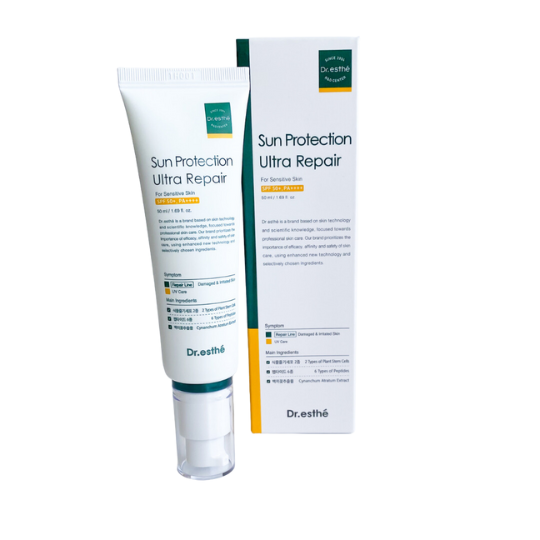
- Dr. Esthé Sun Protection Ultra is ultra-smooth, lightweight, and perfect for everyday wear. Key ingredients include 6 Peptides, Plant Stem Cells, and the patented Derma Clera. Derma Clera supports skin barrier function.
- Dr. Esthé Sun Protection Mild is similar to the formula above, but designed for sensitive, oily, or acne-prone skin. It contains Smart Sebum Control technology to minimize oily shine.
- Klavuu Blue Pearlsation Cushion is a tinted BB cream that provides light to medium coverage depending on how much you apply. It’s easy to reapply throughout the day. It creates a hydrating film over your skin and provides that luminous, glossy skin glow. When I’m in a rush, I use this as my moisturizer and sun care product.
- PFECT-A Solar Elixir Sunscreen is an elegant and silky serum you can apply to your face and body. It’s ultra-lightweight, so you can pat it on over your makeup when you need to reapply. It absorbs instantly with no oily residue or white cast.
-
HOP+ All Mineral Multi-Protection Face & Body Sunscreen is a top pick for vacation and full days in the sun. This formulation has a bit of a white cast, but it’s better than most, and absorbs quickly into your skin. It also contains PLLA to volumize sagging areas of your face and body.

LET’S EXPLORE WHAT YOUR SKIN REQUIRES BEYOND K-BEAUTY SUN PROTECTION
If you want to learn how to tailor your daily skincare routine beyond Korean face and body sunscreen, join the CBE Rewards Club. As a member, you'll get $10 in cash rewards every month, 10% off CBE Botanicals products, and access to the Rewards Club Members Lounge, where you can ask me your skincare questions directly.
Frequently Asked Questions
Are Korean sunscreens better than American ones?
In terms of UV protection, Korean face and body sunscreens have a wider range of UV filters. The defining difference comes down to the other ingredients. Korean brands drive the skinification of sunscreen. This is the philosophy that your sunscreen should hydrate, heal, nourish, and protect. Many formulas feel lighter and have no white cast.
Is it illegal to use a Korean sunscreen I bought overseas?
No. US rules cover how products are sold, not what you put on your skin. Be mindful of expired, heat-damaged, and counterfeit products.
Is SPF 30 twice as strong as SPF 15?
No, the number refers to how much of the sun’s rays are filtered. SPF 15 blocks about 93% of UVB rays, SPF 30 blocks about 97%, and SPF 50 blocks about 98%. And no, layering multiple products doesn’t “add up”. If your makeup is SPF 15 and your moisturizer is SPF 35, your sun protection is SPF 35, not 50.
Do I need sunscreen indoors?
UVA rays pass through glass, increasing your daily exposure. You must also protect your skin from the blue light of digital screens and fluorescent lighting.